
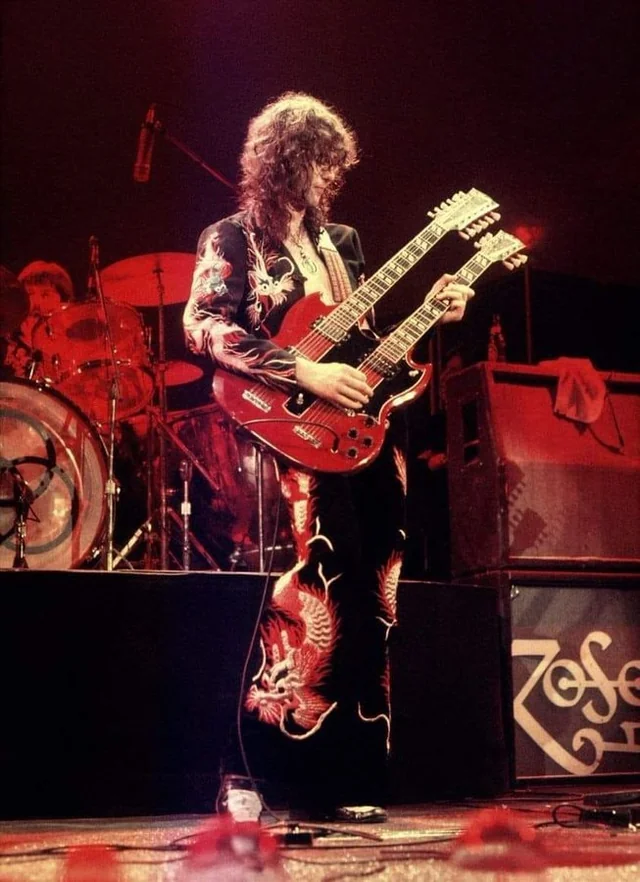
Jimmy Page
Led Zeppelin
The architect of heavy riffs and diverse acoustic textures, Jimmy Page defined the sound of hard rock with his 'light and shade' production philosophy. His tone ranges from the aggression of the 'Dragon' Telecaster and 'Number One' Les Paul to shimmering 12-string chimes, all fueled by a mysterious signal chain of fuzz, echo, and phasing.
SIGNATURE TONE
A massive, dynamic sound built on the interaction between a Les Paul (or Telecaster) and a cranked Marshall (or Supro). Key elements include the preamp saturation from the Echoplex, the aggressive mid-range bite of the Tone Bender fuzz, and the skillful use of volume knob dynamics to clean up the signal. Known for a 'sloppy but soulful' technique that prioritizes emotion and texture over precision.
SIGNAL CHAINS BY ERA
Explore how the rig evolved over time
Early Zeppelin / Yardbirds (1968-1969)
The raw, aggressive sound of Led Zeppelin I. Defined by the 'Dragon' Telecaster into a Supro amp with a Tone Bender fuzz, creating a searing, tight distortion.
Peak Zeppelin / TSRTS (1971-1973)
The iconic 'Number One' Les Paul into Marshall stack era. A thicker, punchier tone with the Echoplex EP-3 preamp adding color and boost.
Late Zeppelin / Physical Graffiti (1975-1979)
Experimentation with modulation like the Phase 90 and the B-Bender Telecaster. The sound became more textured and layered.